

Biological
Repeated threat activation leaves its mark. Your amygdala stays primed, and the body keeps scanning for danger even when there's no threat present anymore.

Something as small as a raised voice, a sudden noise, or someone standing too close can put your whole body on alert. You know, rationally, that you are safe. Your nervous system has not caught up yet.
For many of the people we treat, particularly founders and executives who've spent years operating in high-stakes environments, trauma accumulates quietly across time rather than arriving all at once, until hypervigilance, emotional numbness or avoidance have become the default way of moving through the world.
PTSD can trace back to a single, identifiable event. For Complex PTSD, it tends to be less about one injury than a thousand small ones, with repeated or prolonged exposure accumulating over time. Both conditions share a core set of symptoms: re-experiencing the event through flashbacks or intrusive memories, avoiding reminders of it, and living with a heightened sense of threat that rarely switches off. Complex PTSD includes all of this, then adds three further patterns: difficulty regulating emotion, a persistently negative sense of self, and disturbances in how you relate to other people.
Symptom framework based on Cloitre et al., European Journal of Psychotraumatology, 2013.

Not every point here needs to apply, but this may resonate with you if:
PTSD develops when your body stays locked in threat mode long after the danger has passed. Complex PTSD adds another layer, usually shaped by prolonged or repeated exposure rather than a single event, and it tends to reach further into identity, trust and how safe closeness feels. Standard talk therapies are well established for PTSD, but research on complex PTSD shows more mixed results with talk therapy alone, which is why body-based approaches like EMDR and somatic experiencing are often used alongside it.
What's driving it
Repeated threat activation leaves its mark. Your amygdala stays primed, and the body keeps scanning for danger even when there's no threat present anymore.

Complex PTSD in particular tends to take root inside relationships where safety and threat were tangled together, which is often what shapes how trust and closeness feel long afterward.

Hypervigilance, emotionally shutting down and avoidance are not choices you are making. It's a dysregulated nervous system doing exactly what it learned to survive.
All seven disciplines of the Ascendant 7/21 Method™ run through every program. Three lead the clinical work because trauma is held in the body as much as the mind. The remaining four create a strong foundation of body and mind for the deep work happening in the three core disciplines.
Where the work starts
A full psychiatric and medical review comes first, screening for what else might be going on alongside the trauma, with medication support where it's clinically indicated.
EMDR, schema therapy, IFS and cognitive processing therapy release stored trauma without asking you to relive it in detail. DBT and neurofeedback then rebuild the self-regulation trauma erodes.
Trauma held in the body rarely resolves through talk alone. Somatic release and discharge techniques, alongside grounding, pendulation, sensation tracking and touch-based physiological resourcing, work on it directly, in ways conversation alone doesn't reach.
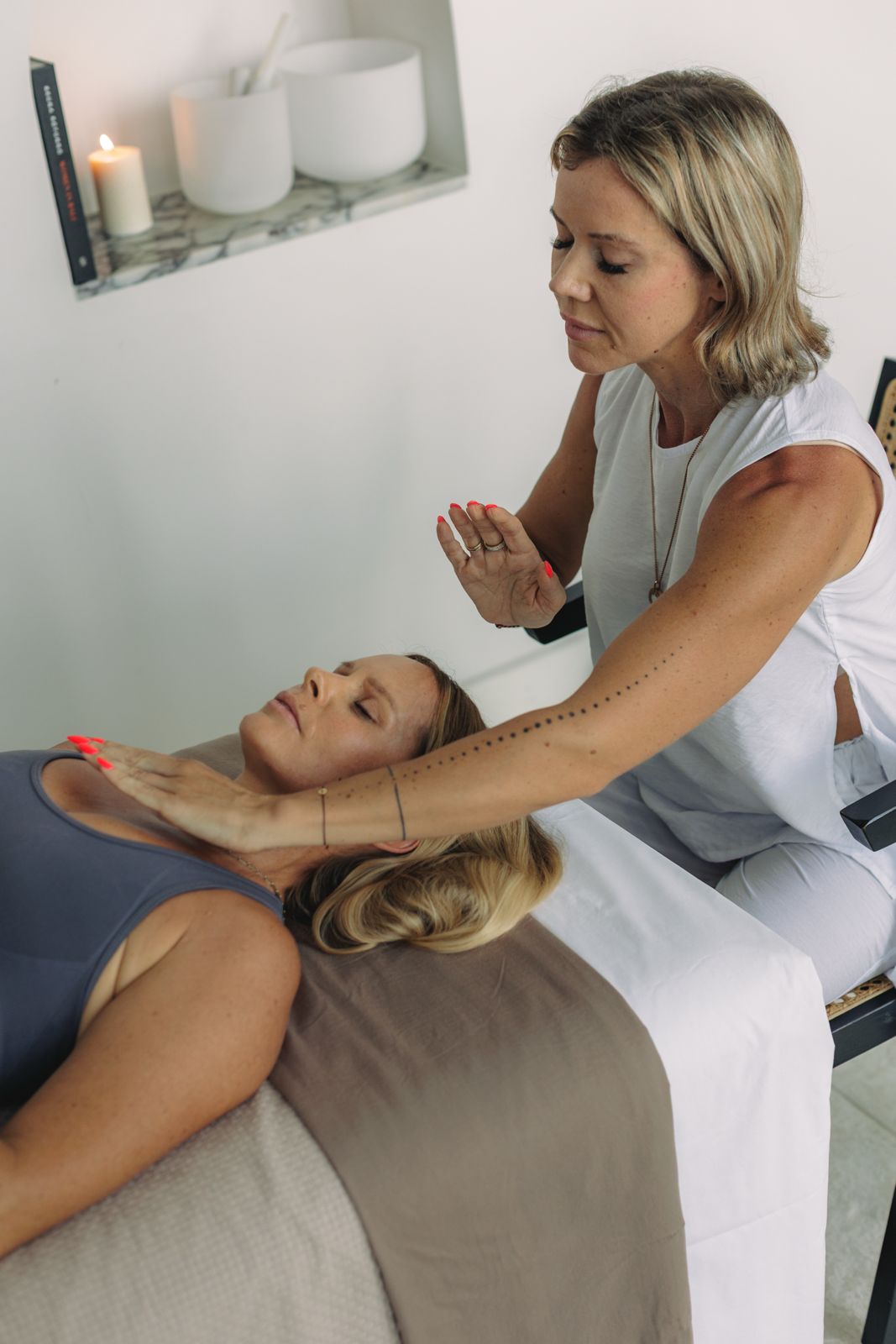
A combination of Traditional Chinese Medicine practices, academic kinesiology, Japanese reiki, and subconscious re-patterning work through the use of tools from positive psychology.

Repeated, controlled experiences of exertion and recovery restore the body's sense of agency and capacity, after trauma often left it feeling powerless or frozen. It also builds interoceptive awareness and discharges stored survival energy, both of which support the somatic and psychological work happening elsewhere in your program.

Consistent, adequate nutrition supports neurotransmitter synthesis, serotonin and dopamine, and reduces the physiological noise that can keep your nervous system locked in a sympathetic or shutdown state.

Targets the biochemical fallout of trauma directly, correcting the nutrient depletion, HPA axis dysregulation, gut-brain disruption and chronic inflammation that keep your nervous system locked in hyperarousal. This physiological repair runs alongside the psychological work, so trauma processing isn't fighting a body still biochemically primed for threat.

Founders, athletes, and creatives carrying trauma quietly for years, while still performing at a high level, this is who the program's actually built around.

No handoffs between providers, no re-explaining your history to someone new each week. The same clinical team from your first session to your aftercare plan.

Recovery extends beyond symptom management to restoring confidence, relationships and quality of life.
Rushing trauma work risks re-traumatisation. Session intensity is adjusted continuously against how you're actually responding.
Hearing another person's trauma can itself be dysregulating. A one-on-one structure removes that risk entirely.
Somatic release, breathwork and sensory therapy reach what EMDR and cognitive processing can't alone.
Four steps from first contact to arrival.
A private conversation, by phone or WhatsApp, to understand your history and what you are looking for.
A deeper conversation with our clinical team to confirm Ascendant Bali is the right fit before anything is booked.
Your 7/21 Method™ program is calibrated to your specific presentation, history and goals ahead of arrival.
Private transfer to the estate, and your first medical and psychological sessions within your first days.
6 phases, each with a distinct clinical purpose.
The first days are about physiological, relational and environmental safety. Your nervous system settles into the rhythm of the program while we establish the clinical baseline everything else is built from.
From here, a comprehensive assessment across all seven disciplines builds a detailed picture of how trauma has organised itself in your body and mind. What we find here shapes what follows.
Trauma can't be processed by a system that isn't ready to tolerate it. This phase builds that capacity directly, through somatic training, polyvagal-informed work and daily practices that begin shifting your baseline state before deeper processing starts.
With a steadier foundation in place, the work moves into direct trauma processing, EMDR and IFS among the approaches used, worked through carefully and at your pace rather than on a fixed timeline.
Processing on its own doesn't hold. This phase is about consolidating what's shifted, building a coherent narrative, and starting to hold your own history in a way that no longer defines or limits what comes next.
Your final phase closes with a detailed, personal plan, clinical handover, relapse prevention and ongoing support structures, so the progress you've made has a clear framework for holding once you're home.

PTSD and complex PTSD recovery runs the standard 3 weeks of the Ascendant 7/21 Method™, with extended 4 to 8 week programs available where complex or prolonged trauma calls for a longer consolidation period.
Every program is clinically led by registered medical practitioners and psychologists, with over a decade of work in the mental health industry.
I felt respected, heard, and like I mattered for the first time in treatment, with agency in my own care at every point in my journey. I feel positive, capable, and live in the present without noise and fear.
I left with distress tolerance and emotion regulation tools that hold up in real life, and interpersonal effectiveness work that reshaped how I show up in every relationship. There's no going back to who I was.
PTSD and complex PTSD, specifically
Yes. Complex PTSD typically requires a longer focus on emotional regulation and relational trust before deeper trauma processing begins, whereas single-incident PTSD can often move to processing work sooner. Your program is calibrated to which pattern fits your history.
Not necessarily. EMDR and somatic approaches are specifically designed to process trauma without requiring a detailed verbal account. You share only what you choose to.
Yes. Many clients arrive without a formal diagnosis. Your clinical team assesses your presentation directly rather than requiring a prior diagnosis.
Standard counselling is typically one session a week. Here, EMDR, somatic and nervous system work happen several times a week across a dedicated clinical team, within a private setting built specifically to avoid re-triggering.
Yes. Session pacing is adjusted specifically around your window of tolerance, and your clinical team is trained to work with dissociation and flashbacks safely rather than push through them.
You leave with a personalised aftercare plan developed with your clinical team and we stay with you for weekly aftercare sessions from 4-12 weeks depending on your package. You also have options for extended stays or ongoing remote support depending on your circumstances.
Speak with our clinical team about a precisely calibrated program for trauma recovery.
We'll talk through what's brought you here and whether Ascendant Bali is genuinely the right fit before anything else happens.
Begin a Confidential Conversation